Home · Skills training
Basketball Skills Training in Oviedo
Basketball skills training at The LAB in Oviedo, northeast of Orlando in Seminole County, covers ball handling, footwork, finishing, defense, and basketball IQ. Coach Irwin places you by skill.
Jump to a skill: ball handling, footwork, finishing, defense, passing and IQ.
Butt down, chest up
Players at The LAB hear two cues every day. The first is “butt down, chest up.” It is the same low, balanced stance for dribbling, shooting, and defense. A player who leans over with the head down cannot move well and cannot see the floor. A player who sits down with the chest up can go in any direction.
The second is triple threat position. When a player catches the ball, they should be ready to shoot, pass, or drive, so the defender has to respect all three. Coach Irwin repeats both cues until players get into position without thinking, even when they are tired.
The cue in 2007
This interview from 2007 is one of the earliest recordings of Coach Irwin teaching “butt down, chest up.” The picture and sound show their age, but the cue is the same one players hear at The LAB today.
Senior Showcase interview with Coach Irwin Hudson, 2007. Watch on YouTube.
“The footwork is repetition. It is a dance step.”
Hakeem Olajuwon, Hall of Fame center, Sports Illustrated, 2011
Ball handling and dribbling training
Ball handling training at The LAB starts with pound dribbles, crossovers, and keeping the ball below the waist, then moves to changing speed. A simple example: stationary weak-hand pounds, then the same pounds walking, then a crossover into a layup. The head comes up when the hand can be trusted, because a player who handles the ball with the head up can see the floor. Defenders are added only after that.
Changing speed is a skill of its own. In a session he posted in May 2026, Coach Irwin has a player slow the dribble on purpose and save the speed for the final move: "Slow the dribble down. Slow it until the last one." Then he names the goal: "Put him to sleep with that dribble."
Footwork
Footwork is the step before the skill. Players practice jump stops, stride stops, and a pivot that does not travel. A shot or a pass that starts off-balance is a footwork problem. The work is slow first, then at the speed of a closeout. In a workout reel from July 2026, Coach Irwin's calls are short and constant: "Jump stop, jump stop. Come on, fundamentals, fundamentals," and later, "Strong pass out, outlet."
Finishing at the rim
Finishing means a layup with the correct foot, both sides, then a counter when a defender takes one side away. Foundations players live on the basic layup. Higher levels add the gather and the body angle. Players finish on the same kind of rim they will see in games, so the work carries over.
Defense
Defense training is stance, hands, and slides without crossing the feet. Players learn to stay between their mark and the basket. Talking on defense is coached out loud. It is a skill, not a personality trait.
Passing and basketball IQ
Passing practice means hitting a teammate in stride, where the ball can be used right away. Basketball IQ at this stage is spacing: where to stand so the ball has a place to go. Coach Irwin teaches it inside the group, because IQ shows up with other people on the floor.
Speed, agility, and VertiMax
The LAB has a VertiMax. It is used when a player's plan calls for it, inside a coached session. See The LAB.
How skills map to levels
Foundations builds the patterns. Developing makes them survive a faster game. Competitive uses them at tryout and game speed. Elite keeps them sharp for older competition. The skill assessment picks the level. Classes are $30 with more than 6 players, up to about 15, and $45 in a small group of 6 or fewer. Private work is booked by phone.
FAQs
How do I improve my ball handling?
Start with a dribble you can control without watching the ball, then add movement, then add a defender. Orlando Hoops builds that in order at The LAB. The assessment shows where to start. There is no shortcut that skips weak-hand work.
How long does it take to master ball handling?
Mastery is not a weekend. Players who dribble with a plan most days improve across a season. He will show you the next piece.
What is the hardest basketball skill to learn?
It depends on the player. For many, the hard part is keeping a skill when the game speeds up: a handle under pressure, or a shot with a hand in the face. That is why levels exist.
Can I work on one skill only?
Yes. Tell Coach Irwin you want ball handling, footwork, finishing, or defense. The assessment still happens so he is not guessing. Private basketball lessons are the cleanest way to stay on one skill.
Skills work happens at The LAB, 4620 Misty Way, Oviedo, FL 32765. A question about one skill, or about where to begin, is welcome at TheRealDrCoach@gmail.com.
How a skill practice is built
Each skill above is coached in a sequence: a pattern the player can repeat, then the same pattern on the move, then a live look if the level allows it. Ball handling that falls apart when the player walks is not ready for a defender. A layup that misses on the strong hand is not ready for a euro step. Defense that stands straight up is not ready for a closeout drill. Coach Irwin stops the session at the step that is breaking down and fixes it there, because each step has to hold before the next one can. A step holds when the player brings full focus to every rep, and that focus is what gives the next step something solid to build on.
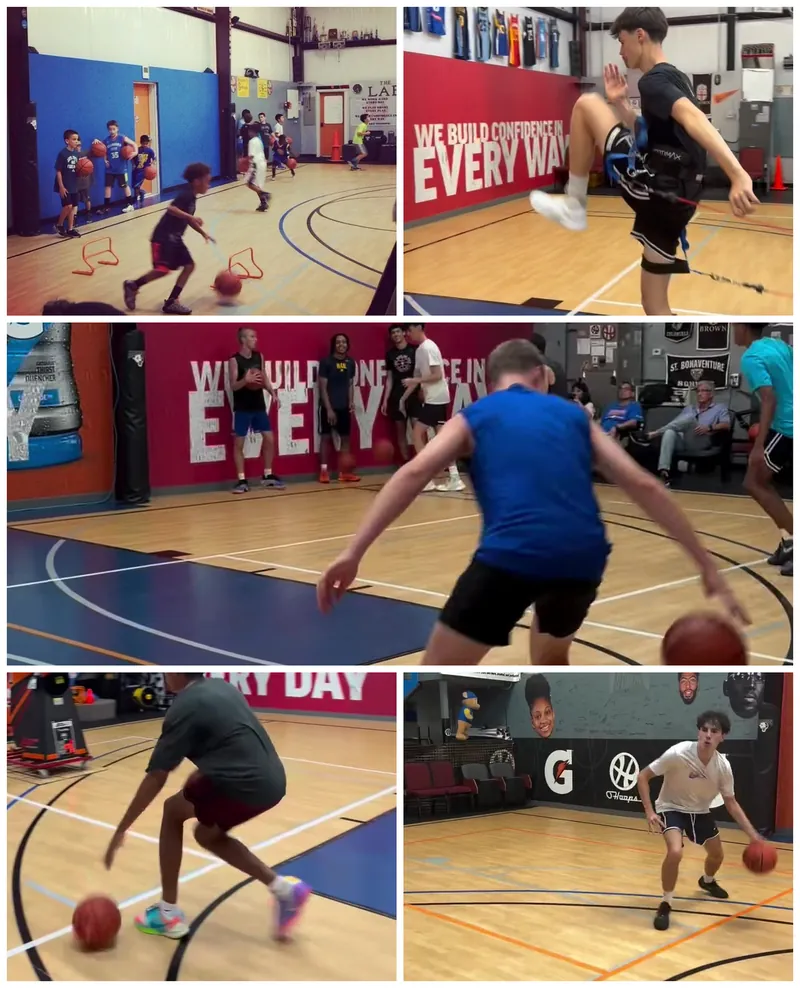
If you want only ball handling for a month, say so. If you want defense before a tryout, say so. Coach Irwin still watches the whole player, because a handle that is ahead of the feet will not hold in a game. Shooting has its own page at basketball shooting training.
Drills stay simple: a crossover into a jump stop, a weak-hand layup, a slide to the left and back. The coach names the mistake in the moment, and the player tries it again. To see this kind of work at The LAB this fall, watch a wing drill Coach Irwin posted in September 2026.
Updated November 28, 2026.